Email Terry Sprague
 
May 20, 2013 at 07:58 PM
Home arrow Opportunities arrow Little Bluff Conservation Area
Little Bluff Conservation Area PDF Print E-mail
Written by Terry Spraque   
Jan 02, 2007 at 05:35 PM

LITTLE BLUFF CONSERVATION AREA

Little BluffIt is difficult to imagine as one drives into Little Bluff Conservation Area, that this scenic lookout, now overgrown with red cedar, once bustled with activity in the late 1800s. Ruins on the western side of this conservation area attest to the agricultural prosperity back then, fondly known as the "Barley Days." Looking at the 60-acre site now, you can barley believe it !

In the late 1800s, the United States was involved in the American Civil War, and the tax on whiskey increased from a modest 25 cents a gallon to two dollars a gallon. As a result American drinkers turned their attention to beer. It was believed that Canada produced superior barley, thus creating an increase in the demand for this crop. In fact, Prince Edward County barley was said to be superior to anything produced anywhere in North America. The 1878 Historical Atlas of Hastings and Prince Edward Counties states, "The land about Bay of Quinte seems more peculiarly adapted to the growth of barley than any other section of America. Crops of that staple are produced which yield fair returns as to quantity, and for quality defy competition; the 'Bay Barley' always being, without exception the highest quotation in the American barley centres."

Between 1860 and 1890, Prince Edward County alone shipped over 15 million bushels of barley, occupying nearly one-third of the total cultivated land in the county. Pioneer fathers who had never been able to grow a surplus of anything watched as their sons and daughters sold crops for cash in quantities never before dreamed of in the area.

Little BluffThe remains of the grain storage bin and dock at Little Bluff is just one of many loading areas that were once sprinkled around the shores of Prince Edward County. County boat yards provided the boats to ship the barley across the lake to Oswego, New York, often making three trips per week. One of the major loading areas was the MacDonald/Hyatt Wharf located just across from the large house formerly occupied by Norman and Keith MacDonald, in what is now Sandbanks Provincial Park.

The prosperity associated with Barley Days, however, could not be expected to last forever. In 1890, the McKinnley Tariff gave American farmers protection from importing commodities. In addition, the centre of the brewing industry shifted from New York State to Milwaukee. Barley obtained from the West was found to be adequate in quality and easier to buy. Overnight, the price of barley in the county dropped by 50 per cent.

Barley Days were over. The memories though of those 30 years of prosperity will never be forgotten. All it takes is a piece of wharf or a fragment of a storage building to recreate visions of enormous schooners loading up for the trip across the lake.

From the parking lot at the end of the entrance road, a short hiking trail introduces you to not only to a monoculture of eastern red cedar, but eventually takes you to these ruins, situated at the lower level of the cliff edge. While red cedars dominate the scene, there are a number of deciduous trees along the edge of the cliff where interesting bird species may be seen as they forage for food in the hardwoods and bushes that hug the edge of the 60-foot cliff. Alternatively, you can follow another trail along the cliff edge to the picnic shelter and parking area.

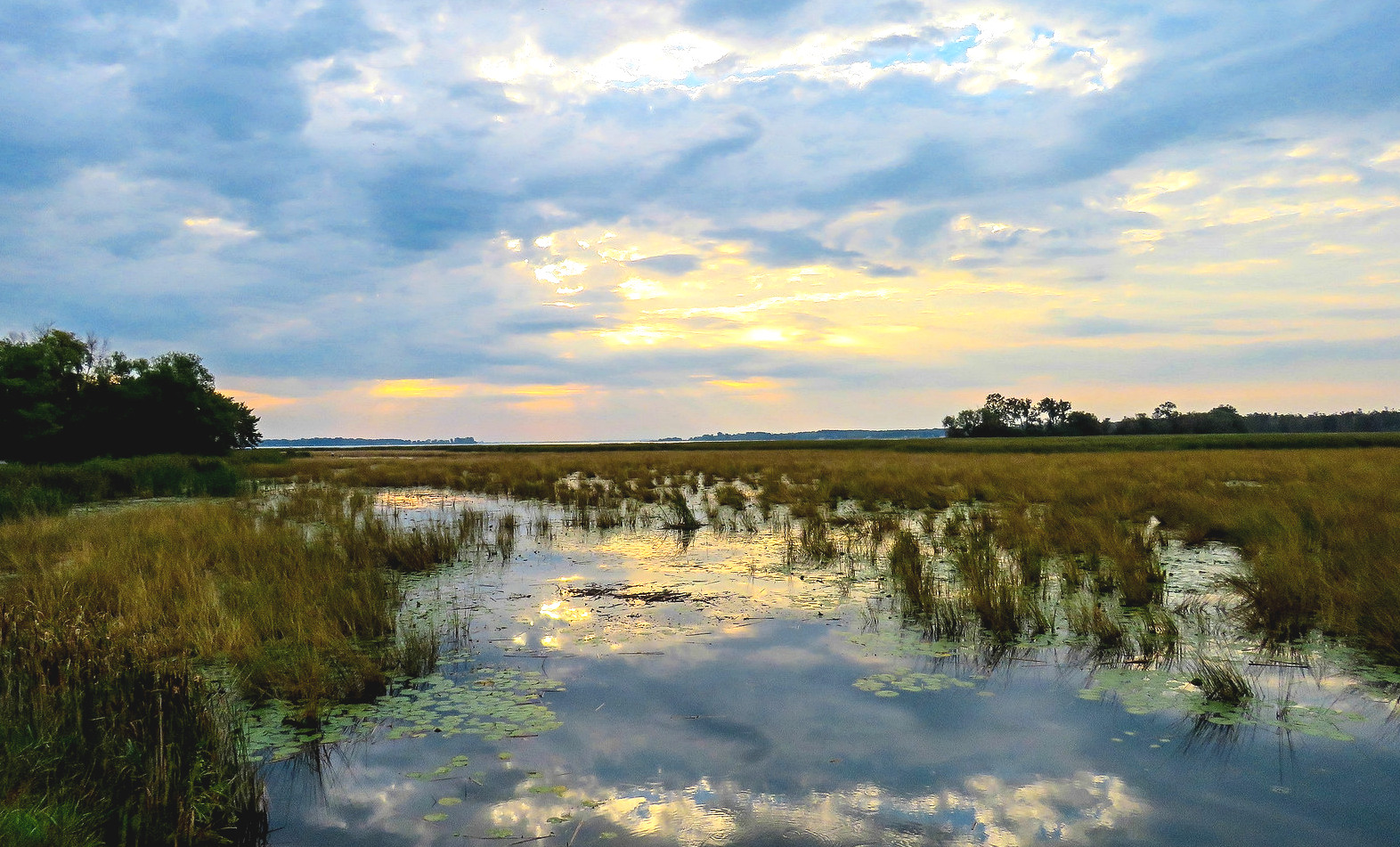
Little BluffOne of the more interesting trails leaves the parking lot near the picnic shelter and takes the hiker along the edge of another precipice, overlooking a small cattail marsh and cobblestone barrier beach. The trail which comes out at a lookout near the roadside and entrance to the conservation area, offers spectacular views of wetland inhabitants including ducks, geese, herons, and a variety of other wetland creatures. Only a few years ago, a scan with the spotting scope from this trail revealed a lone great egret peacefully feeding along the wetland edge below. The variety of bushes and hardwood trees along this trail often harbour birds such as chickadees, woodpeckers and nesting yellow warblers. Plants typical of an alvar environment where soil is thin and moisture often in short supply abound, such as cinquefoil, yarrow, hawkweed and Viper's bugloss.

To reach Little Bluff Conservation Area and its short but interesting walking trails, take County Road 10 (Lake Street) from Picton south for 8 km to Cherry Valley. At the Stop sign in Cherry Valley, turn left and follow County Road 10 for another 6 km to Milford. At the Stop sign, turn left,and then right at the post office, and continue on County Road 10 to the Stop sign at County Road 13. Turn right and follow County Road 13 for about three km and look for the conservation area sign on the left side of the road.


PHOTO CREDITS:

1) From 60 feet at the edge of the bluff, one has a gorgeous view of the barrier beach below
Photo by Terry Sprague (August, 2005)

2) Remains of the grain storage building along the shore remind us an earlier life here during the famous Barley Days
Photo by Terry Sprague (August, 2005)

3) From the barrier beach below, the 60 foot bluff towers high to the observation point above. The tree in the foreground is the location from which the first photo was taken
Photo by Terry Sprague (June, 2005)


Last Updated ( Jan 01, 2013 at 10:17 PM )
 
©2003 Nature Stuff. All rights reserved.